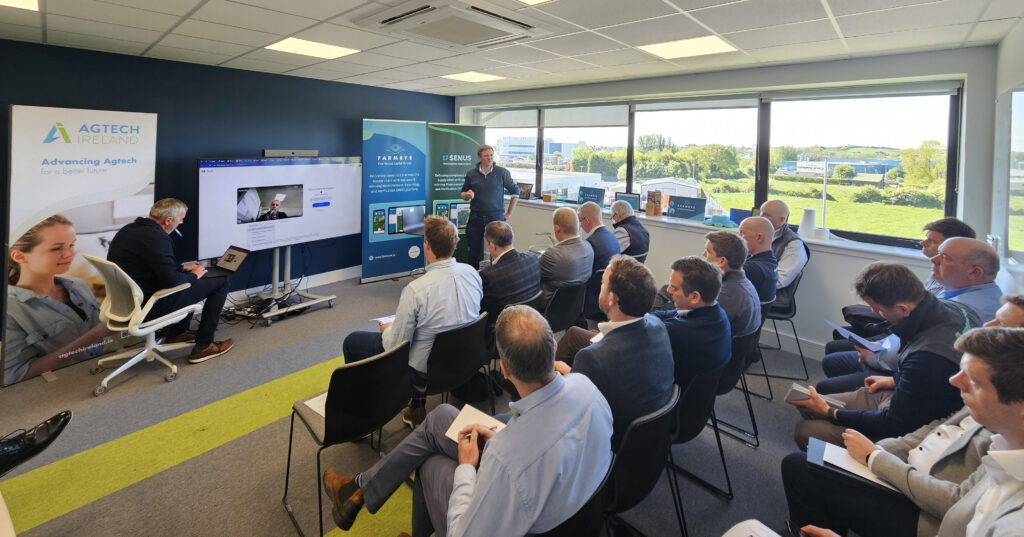
Senus hosted a fantastic session for AgTech Ireland members on 6th May 2026, with Co-Founder and Growth Director Eoghan Finneran generously and openly sharing the business’s journey from university spin-off to Euronext-quoted company.
Senus measures, records and verifies (MRV) soil health, carbon content and biodiversity for agrifood and other companies in Ireland and abroad. The rebrand from Farmeye supports international growth (now in 16 countries) and a client base that reaches beyond agrifood. Late last year, Senus acquired Loamin to secure trained in-field professional services and to develop low-cost remote sensing tools.
Brendan Allen set out five reasons for listing on Euronext:
1. Fast, efficient fundraising through the Euronext Access programme
2. It is designed for entry-level companies
3. Significant capital without losing board control
4. Liquid shares, which can be used to raise funds and to reward and motivate staff
5. Credibility with partners and corporate clients
In hindsight, there was a sixth: listing let Senus rub shoulders with bigger businesses and gave it “currency”, meaning it can raise funds through paper swaps. Senus embraced the heavier governance and reporting load as a way to show the market it is serious and committed to good governance. Brendan also noted that the Assiduous platform, supported by NOVA UCD, helped them engage with Euronext at far lower cost than mainstream providers.
Hugh Sturrock explained how Loamin uses geospatial AI for MRV. It combines ground-truth data with AI predictors to monitor soil and biodiversity. For example, it can predict species locations and use remote sensing to verify deforestation, historically and live, for EUDR compliance. Loamin also assesses slopes, waterways and flood risk to help farmers make informed decisions, such as when to spread slurry in line with RAMS legislation (Scotland). These tools are crucial to the agrifood supply chain.
Stephen Coen presented the new Senus ERA, an environmental reporting tool for financial institutions, agrifood processors and land management/nature restoration clients. It offers regional and site-level assessment and live site-level verification. For example, a restoration group could assess peat depth to find sites suited to forest or wetland restoration. ERA draws on datasets from the EPA, Teagasc and others. It flags at-risk areas and helps farmers record actions that raise their score. A processor such as a dairy co-op can then use that score as proof of on-farm sustainability, and a bank can use it to qualify farmers for “green loans”.
Finally, Enterprise Ireland Senior Client Advisor TJ Hughes gave a thorough overview of EI supports for agtech start-ups and mature companies, covering innovation and R&D, internationalisation, employment, leadership, talent and skills, and sustainability. Lorcan Bannon then facilitated a conversation between TJ and Eoghan Finneran that used Senus as a case study to discuss practical examples of EI supports with the audience.